
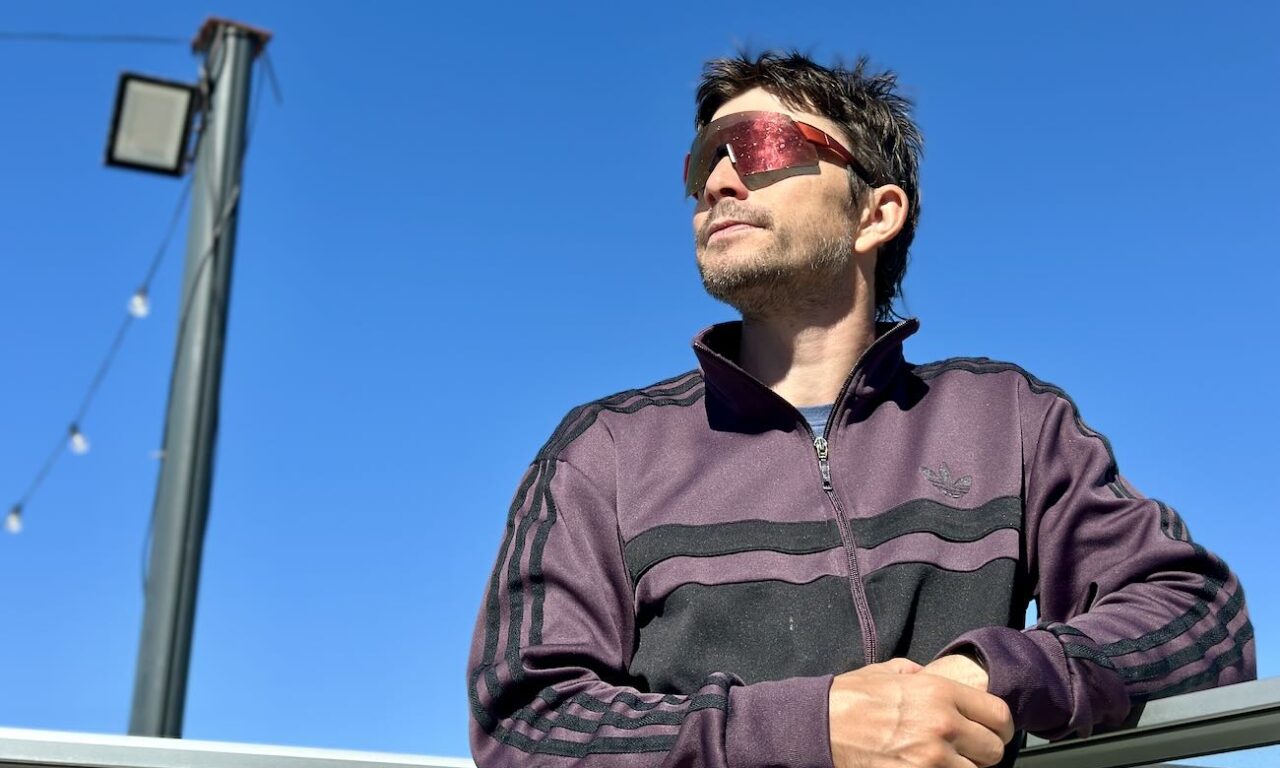
Both an actor and a freediver, Sven Narbonne has found a way to bring together his acting career, the world of images and the underwater realm. Breath, concentration, solitude and control of the body: between the thrill of the stage and the intoxication of the depths, there may be more similarities than we might imagine.
We wanted to introduce you to Sven Narbonne because his journey is particularly unusual in the world of elite sport — and freediving in particular. Originally from Bandol, Sven Narbonne’s background is first and foremost in theatre: he joined the Villeurbanne Conservatory in 2011, went on to work at the TNP, and performed in King Lear, The Misanthrope, Duras and Racine, while also directing and making several notable appearances on screen, including in Drops of God. In 2026, he is still performing in The School for Wives, directed by Robin Renucci. His progress in freediving has been equally remarkable: 202 metres in dynamic bifins in 2024, followed by 212 metres and a 96-metre depth dive in 2025, before recently breaking the symbolic 100-metre barrier in bifins in the Bay of Marseille. Just before the World Championships, we wanted to talk to him about the surprising parallels between these two kinds of performance — on stage and underwater.
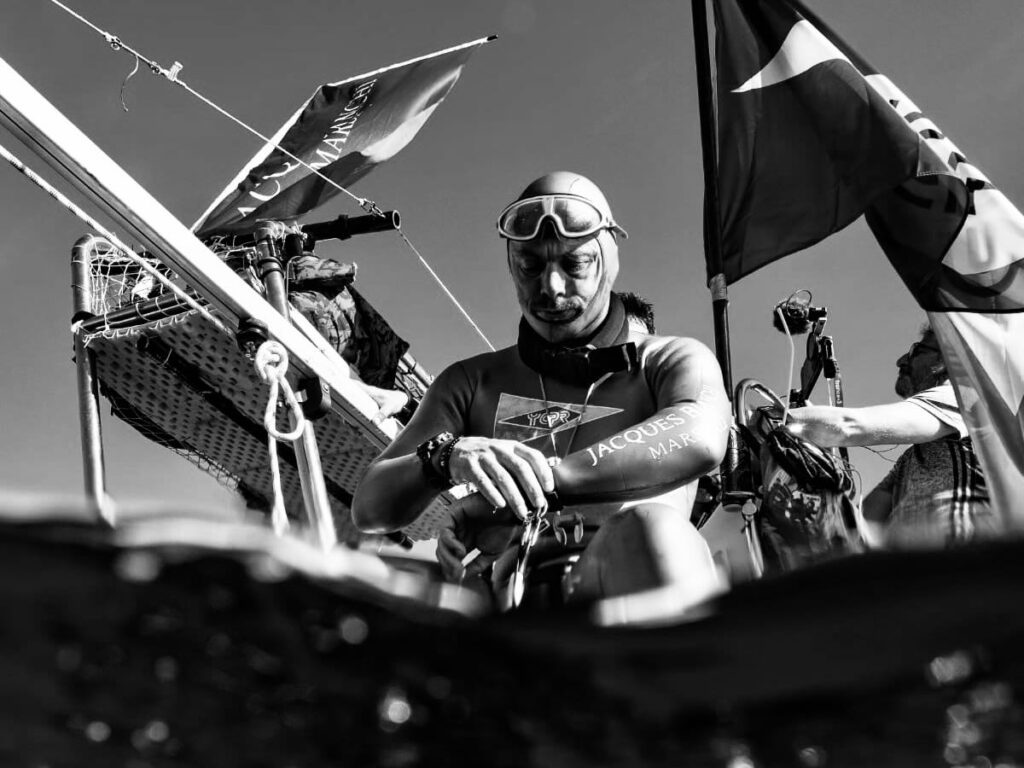
Before becoming an elite freediver, you were an actor, performer and theatre director. How do you go from the stage to the depths of the Mediterranean?
First of all, I’ve had a connection with the Mediterranean since I was very young. I grew up near Bandol, where I would go sailing at weekends and, whenever I had the chance, I would get into the water and explore the underwater world.
Later, I completely fell in love with literature, and more particularly with theatre and Shakespeare. At a time when my life was a little complicated, I found truths in Shakespeare that resonated very deeply with me, and I was able to immerse myself in them. I realised I wanted to devote myself body and soul to those texts, to bring them to life on stage, to speak them and allow people to hear them. To become a conduit between Shakespeare and the ears of contemporary audiences.
Immersing yourself in verse, in the alexandrine, in poetry and free verse resonates very strongly with deep freediving.
You have to give yourself completely to the activity. When you launch into an alexandrine, you take a deep breath and enter into the rhythm of the text, which carries you all the way to the end of the thought. When you freedive, you take a deep breath and descend towards depths where the mind also has a role to play.
Theatre and freediving share many things: breathing, managing stress and managing emotions. Just before going on stage, you can experience stage fright. You can feel exactly the same kind of stress when you’re about to dive twenty, thirty or a hundred metres underwater.
When did freediving stop being a hobby and become a genuine way of life?
To understand that, you need to know that when I talk about sailing as a child, I was already sailing competitively. I’ve always had that competitive streak in the sports I’ve practised, whether sailing, football, tennis or others.
When I discovered pool freediving in 2018 at the Loup Pendu club in Rillieux-la-Pape, near Lyon, it was initially because I wanted to improve my spearfishing. Very quickly, I discovered that there was a whole structure around pool freediving — a federation, competitions — and I was immediately hooked. That desire to compete came back.
It took me a few more years to discover depth freediving in Marseille, in 2023.
It coincided with another slightly difficult period in my life, when the discipline required by deep freediving shook me up and woke me up at a time when I had started to let myself go much more in my everyday life.
On the one hand, if I wanted to perform, I had to change my lifestyle. On the other, the people closest to me, particularly my partner Louise, were able to tell me that I wasn’t myself anymore. It takes courage to say that to your partner and make them understand that certain things need to change.
That desire for competition and depth, combined with the realisation that my life wasn’t completely in balance, is what made competitive freediving a priority.
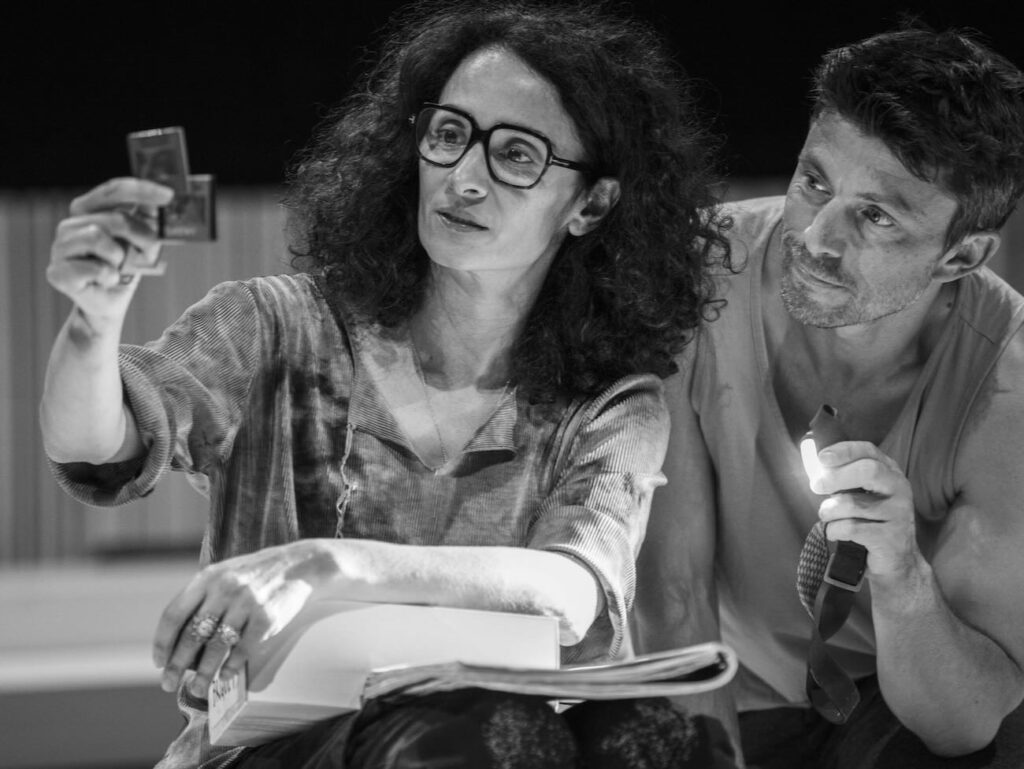
Theatre requires control over your body, your breathing, your emotions and your nerves. Paradoxically, do you find the same mechanisms at work when you’re alone dozens of metres beneath the surface?
Yes, exactly. There are many bridges and parallels between controlling your body on a theatre stage and during a deep dive.
In my everyday practice, when I teach theatre workshops, I now incorporate freediving exercises. And conversely, when I teach freediving, I incorporate theatre exercises.
Because beyond competition, what matters to me is passing things on. Whether in theatre or freediving, teaching and sharing are at the heart of what I do. There is competition on one side and transmission on the other, and that is a fundamental pillar of my daily life.
Today, you’re still pursuing both careers simultaneously, juggling shoots, theatre, training and competitions. How do you reconcile an artist’s life with the physical demands of elite sport?
Today, I’m fortunate enough to still be able to pursue both activities, although theatre is the only one that currently earns me a living.
I’m trying to move towards becoming a professional freediver, looking for sponsors and partners, but it’s a long and difficult road.
So far, I’ve been fairly lucky with my schedules, and I also try to make the most of the times when I’m able to dive.
This year, for example, I missed the French Freediving Championships “because” of work: I was performing in The School for Wives at the Fêtes Nocturnes de Grignan festival. But that’s the way it is. Every year, I try to plan as much as possible so that I can find enough time to train while also working enough to maintain my professional status as a performing artist.
On some projects, we rehearse in the afternoon and perform in the evening, which sometimes leaves my mornings free. In those cases, they’re entirely devoted to strength training, sport, yoga or diving. I make the absolute most of my “free time”, so to speak, to dive and practise freediving.
Your story as a freediver is also very closely tied to Marseille and to the YCPR. How did you start here, and what were the major stages that took you from beginner to instructor and then to the French national team?
Marseille has indeed played a key role in my life as a freediver, particularly as a depth freediver.
Before that, though, I discovered freediving near Lyon, at the Loup Pendu club, with Frédérique Cordier, who at the time was the leading figure in breaststroke pool freediving in France. She taught me many technical aspects: preparation, the final breath and the fundamentals of freediving.
Then, in Marseille, I joined Massilia Sub, one of the city’s historic clubs, which was chaired for many years by Morgan Bourc’his, a former world champion and freediving world-record holder. It was with Morgan that I practised depth freediving properly for almost the first time. We talked during one outing and, at that stage, competing in depth wasn’t something I was considering at all. I only wanted to compete in the pool.
He was the one who planted the idea in my head that I should take depth more seriously and encouraged me towards competition.
At Massilia, I also met people such as Émile Mold and César Theroux. Unfortunately, Massilia no longer quite matched our desire to go deeper and explore competitive freediving further.
So we created the YCPR freediving school, where Émile, César and I are now instructors, with Louise Océane Delion joining the team.
She will also be aiming for selection for the French national team for next year’s World Championships.
Is Marseille a good place to become a depth freediver? What do the bay, the islands and the Calanques offer — or impose — compared with the world’s major freediving spots?
Marseille is a very demanding place for freediving. To get ideal conditions and access serious depth, a lot of different factors have to come together.
Firstly, reaching deep water requires a fairly long boat trip. Secondly, because of its orientation, Marseille is very exposed to the mistral and the swell it generates, while offering very little protection from the swell caused by easterly winds.
Then there is the Mediterranean itself: beyond a certain depth, the water gets colder. This is known as the thermocline, and it is particularly pronounced in Marseille. The water can be 25°C at the surface, fall to 15°C at 20 metres and then reach 12 or 13°C at around 80 metres.
These characteristics make Marseille a demanding training ground. But when we travel to places where conditions are gentler, where the water might be the same temperature throughout the entire water column, our experience here gives us an advantage — or at least means we’re better prepared on a daily basis.
At the same time, the beauty of Marseille’s landscapes, islands and national park, together with its underwater flora and fauna, particularly thanks to the Calanques National Park, make it one of the most beautiful and wildest places to dive. Within twenty minutes by boat, you can reach absolutely magnificent spots.
Another particularity of the YCPR is that we go out all year round, including in winter. We try to organise three to five outings during that period, weather permitting. That introduces another dimension to freediving: it’s cold, and you also work on your mental strength through more difficult dives.
You recently broke the mythical 100-metre barrier in bifins for the first time in the Bay of Marseille. How do you prepare for a dive like that, and what goes through your mind in the minutes before you start?
It takes a long preparation, spread over several years, to reach that 100-metre dive. It’s a unique dive because you only break that barrier once. After that, you simply go back there.
It represents years of preparation since my first dives in April and May 2023. I remember very clearly talking with my coach Émile on Catalans beach. We set ourselves the goal of reaching 100 metres within about ten years. As it happens, I did it in three, but it’s something you think about a long time in advance, and then gradually put everything in place to achieve it.
The training, dietary discipline and lifestyle demanded by the sport determine how quickly you can move towards breaking these barriers.
For me, reaching 100 metres was a real objective. So I prepared rigorously for it from the very beginning.
Then, on the day itself, you have to trust the process, your training and all the experience you’ve accumulated at previous depths. Above all, you don’t suddenly dive to 100 metres overnight. In the preceding days, I had done 92 metres, then 95, then 98, and finally, after a rest day, I calmly set out to reach that truly mythical depth.
You’ve said that the descent becomes almost pleasant once you allow yourself to sink, whereas the final 30 metres of the ascent make your legs burn intensely. Can you take us inside those 100 metres — the sensations, the silence, the cold, the effort, and the moment when you finally see the safety freedivers again?
A 100-metre dive is prepared long before you actually get into the water. Even if you’re diving at 10:30 a.m., the preparation begins at 6:30 in the morning: yoga, stretching, breathing exercises…
Once I’m in the water, on the dive line, I have three minutes before the start. I try to stay focused on my sensations and my breathing, paying attention to what I’m feeling inside rather than what is happening around me, and mentally projecting myself into the dive ahead.
What made this particular dive different was that it was the first time I was going to reach 100 metres, so obviously that was very much on my mind.
Then there are two minutes left, then one minute, then thirty seconds. You start preparing for the final breath. One last big exhalation to empty the lungs completely, then you inhale as deeply as possible. And then: three, two, one — go. You turn over, duck-dive and begin the descent.
Within the first twenty metres, I immediately know whether the dive is going to feel good or not, based on how I perceive the time it takes me to cover that distance. On this dive, it felt very good.
Then I continue down. I know it’s a 100-metre dive, so I try to push that thought out of my mind. I make the movements needed to bring air into my mouth so that I can keep equalising all the way to the bottom. I try to remain focused on the present moment rather than on distractions, negative thoughts or the possibility that I might not make it. Metre by metre, one thing at a time.
My watch has an alarm at 50 metres telling me it’s time to stop kicking. Then I continue sinking to 75 metres. At that point, the dive changes: at 75 metres, the pressure on the body is enormous, your field of vision narrows and you have the feeling that you’ve become part of the element itself.
A few metres before reaching the bottom, my watch sounds — at 97 metres in this case. I extend my arm, open my eyes, find the tag at the bottom and bring it back up as proof that I reached the depth.
Then the dynamic phase begins: the ascent, which lasts about one minute and forty seconds, after a descent that also took roughly one minute and forty.
I start coming back up. I try to think about my technique, to remain disciplined and focused, to stay lucid and precise in everything I’m doing.
At 50 metres, my watch sounds again: it tells me I only have 50 metres left. That’s usually good news. Then, at 30 metres, the first safety freediver meets me. At 20 metres, the second safety freediver joins us.
At that point, you start preparing for the surface, where there is a very precise protocol to follow. Once you break the surface, you have to keep your head above water, make sure your mouth doesn’t go back under, remove your facial equipment — mask and nose clip — make the OK sign with your fingers and then say, “I’m OK.”
I had all of that in my mind, alongside the euphoria of thinking: “That’s it, I’m going to make it.” When I was about twenty metres below the surface, I knew I still had enough energy and lucidity to complete the dive.
There was already an extraordinary mixture of emotions underwater, and once I reached the surface, they completely overwhelmed me.
The deeper you go, the more the performance also relies on a team that remains invisible from the surface: coach, safety team, boat crew, other freedivers… To what extent is a dive that appears intensely solitary actually a collective adventure?
You never dive alone. That’s a fundamental rule, and a dive like this demonstrates exactly why.
To reach a sufficient state of mental relaxation, to be able to tell yourself, “I’m putting my life in the hands of the people at the surface,” you need absolute trust in the circle of people organising the dive and ensuring your safety.
On a dive like this, there is a counterweight system in case something goes wrong. There is a dive coordinator responsible for reading and checking the depths on the boat’s depth sounder, and three or four people providing safety in the water.
We also have medical oxygen on board in case of a problem, as well as direct contact with CROSSMED so that, if necessary, an emergency evacuation can be organised to Marseille’s hospitals, where the hyperbaric medical teams provide extremely effective treatment.
Without all those protocols in place, it’s impossible to dive in a relaxed state. If you don’t trust even one person in that chain, it simply doesn’t work.
The dive is entirely collective in that sense: it is the result of a collaboration between the freediver performing the dive and an entire support system that comes together to make it possible.
For my part, when I’m not doing deep dives like this, I’m also one of the people who coordinate and provide safety for my fellow freedivers at the YCPR throughout the rest of the year. It works both ways.
Your approach to freediving seems to move between three worlds: competition and the pursuit of performance, exploring the underwater world, and imagery. Which of these areas do you most want to explore today?
I would say there is another dimension that freediving brings to the fore, and it’s perhaps the one I’m most interested in exploring through the sport: self-knowledge, inner peace and learning to accept living with yourself.
This is only my own view, but in order to live in a complex world — to put it mildly — where human relationships can be difficult, it’s important to know how to face yourself, to look at yourself in the mirror and try to become the best version of yourself. To have the courage and honesty to recognise that there are things you can improve.
I think freediving allows you to ask yourself those kinds of questions. Beyond imagery, performance and competition — all of which are important pillars of freediving — what interests me most is trying to be as honest with myself as possible and continuing to learn about who I am.
And by doing so, I hope I can become a better person for my fellow citizens and for the people I share my life with.
Interview by Eric Foucher
